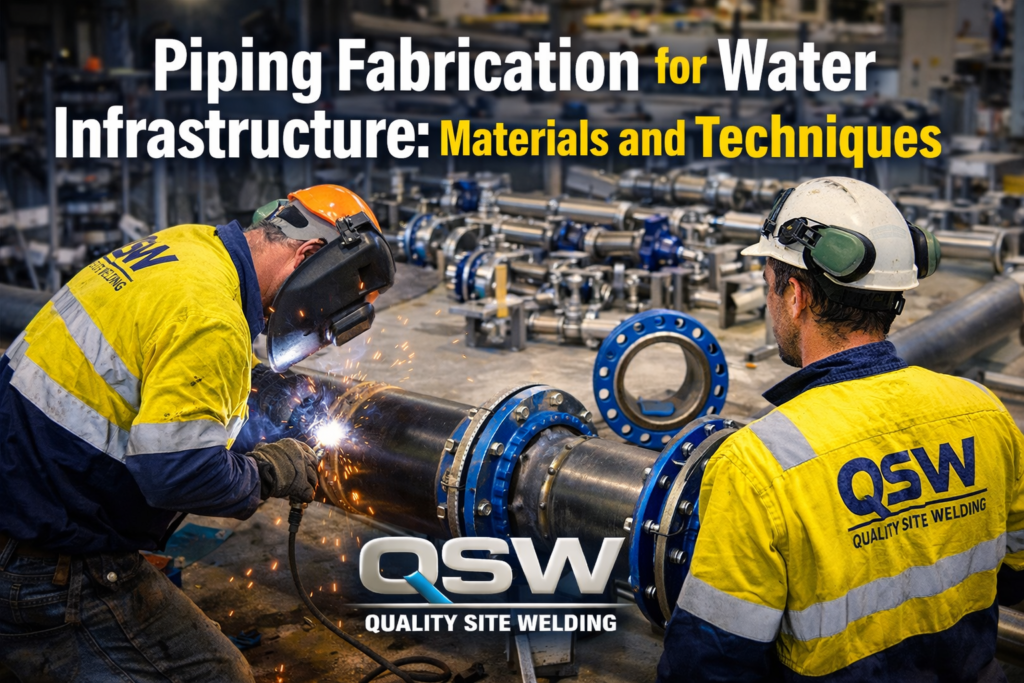
Pipework fabrication for water infrastructure requires more than producing components to a drawing. Materials, weld procedures, dimensional accuracy, testing and installation requirements must be considered before fabrication begins. Quality Site Welding manufactures and installs pipework for pump stations, treatment plants and water infrastructure projects across Melbourne, Gippsland and regional Victoria.
This guide explains the materials, fabrication methods and quality controls used in water infrastructure projects, and what decision-makers should look for in a mechanical pipe fabrication contractor.
If you are planning a new installation or upgrade, you can also explore our dedicated Piping & Mechanical Installation services.
What Is Piping Fabrication in Water Infrastructure?
Piping fabrication involves cutting, preparing, welding and assembling pipe components such as:
- Pipe spools
- Manifolds
- Valve assemblies
- Pump connections
- Structural pipe supports
These components are built in accordance with engineering drawings, project specifications and Australian Standards before being installed onsite.
In water and wastewater environments, fabricated pipework must meet strict authority requirements. Even minor dimensional errors can create major installation delays. Incorrect welding procedures can result in leaks during hydrostatic testing. Poor material selection can shorten asset life.
Fabrication is therefore a technical discipline that directly affects long-term system performance.
Key Materials Used in Water Infrastructure Pipe Fabrication
Material selection is one of the most important decisions in water pipeline fabrication. Each material behaves differently under pressure, chemical exposure and environmental conditions.
Mild Steel
Mild steel is commonly used in pump stations and mechanical manifolds where strength and cost efficiency are important. It is typically protected with internal linings and external coatings to manage corrosion risk.
It is well suited for structural pipework and larger fabricated assemblies.
Stainless Steel
Stainless steel is widely used in wastewater treatment plants and corrosive environments. Grades such as 304 and 316 offer strong resistance to chemical exposure and moisture.
Stainless steel pipe fabrication requires strict weld control and finishing processes to preserve corrosion resistance.
HDPE
High-density polyethylene is frequently used in buried water and wastewater pipelines. It provides flexibility and corrosion resistance but requires specialised fusion welding techniques.
Ductile Iron
Ductile iron remains common in trunk mains and authority infrastructure. Fabrication often involves flanged connections and tie-ins rather than full welded assemblies.
Material choice is typically governed by project specifications and industry frameworks such as those referenced by the Water Services Association of Australia.
Selecting the correct material at the outset prevents long-term asset issues.
Fabrication Techniques Used in Water Projects
Water infrastructure pipework must be fabricated with methods that ensure structural integrity and compliance.
Cutting and Preparation
Accurate cutting and bevel preparation are essential to maintain dimensional tolerance. CNC cutting, cold cutting and precision beveling ensure clean weld joints and alignment.
Welding Methods
Different materials require different welding processes.
TIG welding is often used for root passes in stainless steel systems to achieve full penetration and internal weld quality.
MIG and stick welding may be used for structural or heavier mild steel applications depending on project specifications.
HDPE systems rely on butt fusion or electrofusion, requiring calibrated equipment and certified operators.
All welding must follow documented weld procedure specifications, with qualified tradespeople completing the work.
Fabricated Pipe Spools
In complex pump stations and treatment plants, pipe spools are pre-fabricated in the workshop. This improves quality control and reduces onsite labour.
Spools are labelled, inspected and prepared for staged installation.
Workshop Fabrication vs Onsite Fabrication
Most high-quality piping fabrication for water infrastructure begins in a controlled workshop environment.
Workshop fabrication allows for:
- Better weld quality control
- Consistent dimensional accuracy
- Safer working conditions
- Structured QA processes
However, onsite fabrication is sometimes required during shutdowns, upgrades or tie-ins to existing assets.
When fabrication and mechanical installation are delivered by the same contractor, coordination improves significantly. This reduces alignment issues between civil and mechanical trades and improves commissioning outcomes.
Learn more about our experience in delivering pump station and treatment plant works across Victoria.
Quality Assurance and Compliance in Water Infrastructure Fabrication
Water and wastewater assets are subject to strict compliance frameworks. Fabrication must align with project Inspection and Test Plans and relevant Australian Standards.
Typical QA processes include:
- Weld inspection and visual checks
- Non-destructive testing where required
- Material traceability documentation
- Hydrostatic pressure testing
- As-built verification
Hydrostatic testing is critical before commissioning to confirm system integrity.
ISO-aligned quality systems help ensure that safety, environmental and documentation requirements are met. In public water infrastructure, compliance is non-negotiable.
Common Challenges in Water Pipeline Fabrication
Water infrastructure projects present unique fabrication challenges.
Corrosion exposure in wastewater environments demands careful material and weld selection.
Access constraints within pump stations may limit spool size and require staged installation.
Shutdown windows are often tight. Fabrication must be accurate the first time to avoid operational disruption.
Coordination between civil, structural and mechanical trades must be precise to avoid rework.
An experienced mechanical pipe fabrication contractor anticipates these issues during planning rather than reacting to them onsite.
Piping Fabrication for Water Infrastructure in Victoria
Across Melbourne, Gippsland and regional Victoria, water authorities and tier-one contractors require fabrication partners who understand authority standards and local conditions.
Projects range from small pump replacements to major treatment plant upgrades.
Fabrication must align with:
- Authority-approved drawings
- Regional compliance requirements
- Pressure and performance specifications
- Long-term maintenance considerations
Local experience matters. Fabrication that looks correct on paper must also perform under real operational conditions.
Why Integrated Fabrication and Installation Matters
Many contractors separate fabrication from installation. While this can work, integration reduces risk.
When the same team fabricates and installs the pipework:
- Dimensional accuracy improves
- Communication gaps reduce
- Installation sequencing aligns with fabrication
- Commissioning issues decrease
For water authorities and infrastructure contractors, this translates to smoother delivery and fewer surprises during testing.
You can explore our broader mechanical and infrastructure services.
Frequently Asked Questions
What is piping fabrication for water infrastructure?
It is the process of cutting, welding and assembling pipe components used in water and wastewater systems in accordance with engineering and authority standards.
What materials are most common in water infrastructure pipework?
Mild steel, stainless steel, HDPE and ductile iron are commonly used depending on corrosion exposure and pressure requirements.
Why is stainless steel often used in treatment plants?
Stainless steel provides strong corrosion resistance in wastewater and chemical dosing environments.
How is fabricated pipework tested?
Hydrostatic pressure testing, weld inspection and QA documentation are standard before commissioning.
Is pipework fabricated in a workshop or onsite?
Most complex assemblies are fabricated in a workshop for quality control, with some onsite fabrication required during tie-ins or shutdowns.
What standards apply to water infrastructure fabrication?
Australian Standards and authority specifications apply, along with ISO-aligned quality processes and project-specific Inspection and Test Plans.
Can fabricated pipework be customised for pump stations?
Yes. Fabricated manifolds and assemblies are tailored to pump layouts, valve configurations and site constraints.
Does fabrication impact long-term asset life?
Absolutely. Accurate fabrication reduces stress, vibration and corrosion risk, extending asset life and lowering maintenance costs.
Speak With a Water Infrastructure Fabrication Specialist
If you are delivering a pump station, treatment plant upgrade or water pipeline project across Melbourne or regional Victoria, ensure your piping fabrication is completed to the correct standard from the outset.
Quality Site Welding provides compliant pipework fabrication and integrated mechanical installation for water infrastructure projects.Contact our team to discuss your project requirements.